I haven't posted in a year, so it's time to either revive this blog--or bury it. Think I'll bring it back.
Two weeks ago I published a syndicated editorial on fracking through Blue Ridge Press (BRP). I learned a number of startling things while researching the piece--and after it was in print.
I discovered while interviewing Sharon Wilson, a regional coordinator for Earthworks, that the natural gas industry has been exempted from seven major federal environmental regulations. Why haven't I read that before? Why isn't that fact front and center in the debate over the health and environmental safety of fracking?
Those exemptions include a pass on Clean Water Act and Safe Drinking Water Act. The so-called "Halliburton loophole", pushed through by former Vice-President/former Halliburton CEO Dick Cheney, exempts corporations from revealing the chemicals used in fracking fluid--some of which are proven carcinogens.
Another loophole leaves hazardous waste, including contaminated soil, water and drilling fluids, unregulated by the Resource Conservation and Recovery Act.
Still another loophole dodges the Superfund law, which requires that polluters remediate for carcinogens like benzene released into the environment.
While researching this story I also learned how much money the natural gas industry throws at Congress to line their re-election coffers--especially those on key energy and environmental committees. Republicans received at least three times more cash than Democrats.
After the 700-word editorial was published in newspapers across the country, with a longer version on 90-some websites and aggregators, I got a peek into the contentiousness of this debate. Editors contacted my BRP editor, Glenn Scherer, shocked by the number of furious letters they'd received. Some people also found my personal email and sent me long-winded, ranting, demeaning letters--some far longer than the editorial itself. Each was rife with misinformation.
You can read the long version of my piece here:
The Fracking Industry Buys Congress
There are so many fronts on this debate, from water usage (in 2011, during the worst drought and biggest wildfires in Texas history, the natural gas industry used more than 13 billion gallons of Texas water in fracking operations). Recent studies in Colorado have shown that methane releases from fracked wells were far higher than estimated, discounting industry's claim of substantial climate change benefit over coal. An article in this issue of Rolling Stone lays out fracking as a ponzi-scheme land grab: The Big Fracking Bubble: The Scam Behind the Gas Boom And then there are the earthquakes in Texas and Missouri and Ohio.
Nationwide, residents living near fracked gas wells have filed over 1,000 complaints of tainted water, severe illnesses, livestock deaths, and fish kills. Complaints sometimes involve hundreds of households. But despite rising debate, there is a veritable gold rush of new natural gas wells being dug across the country, now numbering about 493,000 across 31 states.
Tuesday, March 6, 2012


Monday, January 3, 2011
Back in Delhi
Am back in the crazy, mass-of-humanity cacophony of Delhi, horns honking, maniacal traffic, air choked with wood smoke. Great to see old friends, but am missing the thick bamboo forests, the gymnastic langurs, the peacocks, the sambar deer. The squadrons of dragonflies that hovered over the open grasslands. The midnight howling of jackals. The night sky awash with a canopy of stars. The majesty of tigers, among the world's most magnificent creatures. Missing almost daily time spent with the working elephants that are used to patrol the tiger reserve.
I love the animals.

I love the animals.

Sunday, December 26, 2010
Tiger kill
We started our day today with a 7:00 AM ride on elephant back to a clearing where a tiger was devouring the sambar deer he’d killed during the night. He was the area’s alpha male, a huge cat, knawing away, ignoring the three elephants that circled him from 30 feet away. The park charged $15 per person for a few minutes with him; we were there to photograph the tourists. We returned two hours later: by then he was full-bellied and ready for a nap, occasionally hissing at one of the elephants. He was done with the show.
We got the word that a mother tiger had killed a cow outside the national park. It was near a small village, so the parks department opted to bury the kill to prevent the female and her three nearly-grown cubs from hanging around and eating it. They sent in four elephants. The mahouts were instructed to drive the cats away from the village.
The tigers were on the move as we raced back and forth in a car trying to find them. Villagers worked their fields, kids walked around and played, people rode bicycles and motorcycles along the dirt roads. It was chilling to see them engaged in the dailiness of life, oblivious to the danger.
Then we glimpsed a tiger loping through a field, chased by the elephants. A minute later, we heard a blood curdling scream. The female was so stressed that when she encountered a man he attacked. He died about an hour later. Soon after, we heard a dog screaming—she'd gotten it, too.
The cat wandered into a hotel compound and went to sleep. Her cubs stayed in the village, hunkered down in a thick stand of bamboo.
Today near Todoba Tiger Reserve, about five hours from here, another tiger killed someone. And yesterday a tiger was shot in a rice field in Uttar Pradesh.
Trying to save tigers in an overpopulated country is not easy, and both humans and tigers suffer.
Someone who was born here in Bandhavgarh and who now works as a guide told us over a beer at the end of the day that despite government claims that there are 65 tigers in the park, there are really only about 45. And in Ranthambore, another famous tiger reserve, they have lost six or seven tigers in the last two months.
Tomorrow we’ll attend and photograph the funeral. The man who died was a poor villager in his late 20s, a man who lived in a bamboo hut with his wife and two small children. Donations from the local tourism lodges will pay for the firewood for his funeral pyre, which will be lit in the middle of an open field.
To bed. I’m exhausted and numb.


Friday, December 24, 2010
Bandhavgarh
Am in Bandavgarh, staying on the periphery of the famous tiger park. We head in each morning as predawn light pales the sky, driving in an open safari jeep. At that hour, the park is shrouded in mist, a veneer of frost dusting the straw grassland in wintry white. We look like mummies, wrapped in down clothing. It's not the steamy, sun-baked world one would imagine when picturing India. But the temperature climbs with the rising sun, hitting 65 or 70 F. (18 to 21 C.) by midday. We strip down layer by layer until the chill returns with the setting sun.
Much of the forest is a deciduous mix of silk cotton, teak, sal, and ebony, woven together by mammoth strangler figs and tall thickets of bamboo. We see sambar deer tall as a horse. Small and large herds of spotted deer. Two peacocks fly across the road trailing impossibly long, magnificent plumage. As we approach, big blond langurs bound away on springy legs, the gymnasts of the forest, and a pair of bushy-tailed jackals head for the undergrowth.
Estimates vary, but up to 60 tigers roam this area, slipping in and out of the chain link fence that surrounds the 1500 square kilometer park. Cattle graze within sight on the other side. Hunting them is child’s play for a tiger—and killing them invokes the wrath of the villagers.
We meet a park guard. News comes across his walkie talkie in staticky bursts: three near-adult cubs are in the area. We sit and wait, but don’t see them.
We drive through the park, dust rising in clouds behind us. We see enormous tiger prints, fresh ones, and follow them. And there she is: a female watches us briefly, then slips into the forest, reappearing further on. In side view we can see how huge she is, and how utterly magnificent. Wow.
~~~~~~~~~~~~~
But the next day--we watch three tigers up close for half an hour--20 to 50 feet away!


Tuesday, September 21, 2010
In the Pantanal
This "flooded landscape" is as dry as it ever gets, the rivers down some 12 to 15 feet. It's the end of the dry season amidst the worst drought in 40 years. The profusion of wildlife here is stunning--and it's all drawn down to the river at this time of year.
I've seen my first-ever jaguars, something I've dreamt of since I first stepped foot into Latin American rain forests two decades ago. This is the only place to see these elusive animals.
Have been in the field with biologists--and trapped and radio-collared two cats over the last three nights.
More to come.
Wednesday, July 14, 2010
Dirty Water
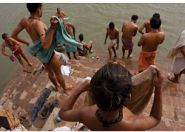
This is from my article "Dirty Water: India and China share a grave environmental problem—extreme water pollution" that was just published in Scientific American Lives--a special issue that launched a new magazine. To read the rest of the story, click on the title to this post.
The hazy dawn knits river to sky on the banks of the holy Ganges river in Varanasi. Even at sunrise, the city’s 4.5-mile waterfront bustles. Bathers brush their teeth, soap themselves, and scrub their children. Legions wash laundry, gather water, and scour dishes. Men swim and lounge on ghats (steps that descend into the Ganges). Black noses and curving horns betray the presence of submerged water buffalo.
Women in bright saris gather in groups or with their families at the water’s edge. Up to 60,000 pilgrims journey to this sacred, 3,000-year-old city from across India each day. They sculpt altars in slick, gray mud, making offerings of flowers and candles. They pour Ganges water, pray, take a sacramental sip and immerse themselves in the turbid river for spiritual healing.
At the “burning ghats,” flames consume the bodies of the dead: Hindus believe casting their remains into the Ganges guides their souls to heaven. To them, this river is the mother goddess, Ganga Ma, who washes away humanity’s sins.
Four hundred million people rely on the Ganges watershed for drinking water, including Varanasi’s 1.6 million residents. But along its 1,560-mile journey from the Himalayas to the Bay of Bengal, the river absorbs raw sewage from 116 cities. Waste has turned these waters into a highway for viruses and bacteria, including deadly, dysentery-causing microbes like E. coli O157 and Shigella, and those that cause cholera, hepatitis A, and typhoid fever. Last year, the Indian government pledged $4 billion for river cleanup to stem the tide of waterborne disease.
But the problem of environmental water pollution extends far beyond the Ganges. Municipal waste, pesticides, and industrial chemicals foul waterways and drinking water across the globe, with the worst pollution concentrated in developing countries. If India’s waterways are the dubious poster children for sewage, then China’s waters take that role for toxic chemicals. Municipal waste is also a severe problem in China, but three decades of meteoric industrial growth have laced lakes and rivers with a witches’ brew of chemicals. Some Chinese waters are now among the most polluted on Earth.
Monday, January 18, 2010
Pangolins in peril
I've written on the Asian wildlife trade many times over the last years: the Asian turtle crisis, with turtles of many species being vacuumed off the Asian continent and eaten to the brink of extinction in less than a decade. Turtles are now being shipped or smuggled from across the globe, from Africa, the U.S., and every part of the globe, valued for their meat (and the longevity it is thought to impart) and used for Asian traditional medicine.
I've also written on the trade in tiger bone and other tiger parts, focusing on India's precipitous decline--catastrophic losses that were finally admitted by the government after decades of coverups. Nearly all parts of the cat, from eyes and whiskers to genitals and tail, are prescribed for their purported medicinal and aphrodisiac powers.

This month, I have a story on the Southeast Asian trade in pangolins--shy, armadillo-ish animals. They are the most-traded mammal on the illegal wildlife black market. Prices for their meat, organs and scales has skyrocketed from $10/kilo in 1990 to between $160-$250 today. Their precipitous decline prompted re-listing of two species, the Chinese and Malayan pangolins, from near-threatened to endangered.
Asian traditional medicine needs to adopt substitutes for endangered species--and needs to substitute manufactured synthetic compounds for animal ingredients. With pressures from habitat loss, disease, climate change, and so much more--animals can no longer be taken out of the wild in large quantities for any reason. Many species cannot survive even small losses.
You can read this story online: http://www.defenders.org/newsroom/defenders_magazine/winter_2010/on_the_ground_pangolins_in_peril.php
Tuesday, December 22, 2009
PLASTICS
The avalanche of plastic that is being produced, used and discarded across the planet has grown exponentially since these polymers first became popular during the 1950s. But this is one problem that we can truly address as individuals--though we also need to push for regulation to protect both our own health and that of a planet that is drowning in plastic.
Thursday, August 6, 2009
Big Coal is Worried
You know they're in a corner when the dogs start snapping.
The recent discovery that the coal industry was forging letters to Congress trying to herd them away from climate legislation shows how worried they really are.
Check out this article in yesterday's NY Times: Congressman Demands Answers on Forged Letters
The last administration handed over our national parks, coastlines and mountaintops to mining and drilling, having a fossil fuels party and ignoring the growing spectre of climate change. It's more than time that we step and take serious action to mitigate greenhouse gases--and for once, put corporate interests aside for the good of the planet.
Saturday, July 25, 2009
Drugs, guns, gangs--and turtles

It is wild here, the stories are intense. Guns and drugs, lots of both.
Hit the ground running yesterday--4:30 rise, drove across the country and got on a Navy gunboat to explore a deserted island for hawksbill turtle nests--with an armed soldier.

Only two years ago, researchers discovered the last, best population of Eastern Pacific hawksbill sea turtles. Researcher J Nichols has jumped in here to try to quickly protect them--perhaps 100 turtles. Earlier this year, egg collecting was outlawed--up until now 95+ percent of the eggs were harvested and sold.
The big issue here is dodging the drug traffickers--some beaches and islands are totally off-limits. The police won't even enter these areas.

Wednesday, July 1, 2009
LONDON
Am in London at the 6th World Conference of Science Journalists (WCSJ): I was lucky enough to be given a Laura Van Dam Fellowship from the National Association of Science Writers to come here. Have attended great sessions on the state of science writing, journalism, book publishing, and new media, as well as specific issues like how science innovation will be needed to address burgeoning global needs for food, water and energy amidst the growing spectre of climate change. I was thrilled to hear John Beddington, the UK's Government Chief Science Advisor, bring up the need for population control and education of women--and identify big barriers to that as one world religion that still prohibits contraception and another that discourages the education of women. This issue is one that most governments and NGOs will not touch, and to me, is the pink elephant in the living room.
Fascinating to hear a global perspective on these and other issues from European, African, Asian, Australian journalists. Particularly interesting to hear differences in health care and health care costs and marketing (particularly pharmaceutical marketing) from European and Canadian journalists.
Also had some personal time with Darwin today: stepped into Westminster Abbey and saw his tomb, and in the evening, attended a WCSJ gala at the Natural History Museum. They just moved a huge marble statue of Darwin to the head of the main stairway to mark the 200th anniversary of his birth and 150 years since the publication of On the Origin of Species. Later this year, the museum will open a brand new building named for Darwin. I had the honor of attending the event with a colleague, Victoria Costello, who was the other Van Dam recipient.


Sunday, May 10, 2009
Water Wars
Some say that freshwater is the new oil. Many predict that with growing population overshadowed by the spectre of climate change, wars of the future will be fought over water, not crude.
In the U.S., battles over water rights have a long history in the West, but conflicts over water--and particularly groundwater--are now occurring across the country.
Check out my recent syndicated editorial. Welcome to the Water Wars.
In the U.S., battles over water rights have a long history in the West, but conflicts over water--and particularly groundwater--are now occurring across the country.
Check out my recent syndicated editorial. Welcome to the Water Wars.
Tuesday, February 10, 2009
More dead tigers in India
There's more bad tiger news from India. Nine tigers have died in Kaziranga National Park, in Assam, in the past few weeks.
Kaziranga is one of eight new tiger reserves established by the Indian government over the last year. They were created in reaction to a grim report documenting a stunning 60 percent drop in tiger numbers from just five years ago: At most 1,411 tigers—perhaps as few as 1,165—still inhabit the country, marking an all-time low.
Kaziranga was considered to be one of few places in India where the cats are safe from poachers. Apparently not, although some of the deaths were attributed to natural causes.
Read more about the state of tigers in India in my recent article: Tigers in the Tank: Can we halt the decline of India's big cats before it's too late? It's the cover story in the current issue of Defenders Magazine.
Tuesday, November 25, 2008
In the desert
November 7th, 2008, Thar desert, Rajastan
We spent the day under the relentless scorch of the desert sun, moving across a scrubby landscape only softened by occasional low, undulating dunes. We visited a three-hut village where two men sheared wild-eyed sheep with ancient, rusted scissors that looked better suited for hedgerows. Women in dayglo-colored saris glittered with gold and silver thread against the sandy monochrome backdrop, brass water jugs, a pile of sticks or a sack of grain piled atop their heads. Midday, weathered men draped in white cotton dhotis, topped in brilliant orange or magenta turbans, lounged in the shade away from the grudging sun.
I love a man in a turban.


Here, girls are still sent off to their husband’s home in arranged marriages at 10 years old, maybe as old as 14. Extended families live together in stone or mud homes that remain closed up and tomb-like against the heat. It’s a hard life, with little water, scarce resources, and even now, heading into “winter”, heat waves ripple in 90-something degree heat midday. It hits 120 in the summer.

On the way back to our lodgings I lounged on my back, rocking on a camel cart beneath a canopy of stars. The sand glowed under the hanging sickle moon, bells tinkled on the dromedary's ankles, and a chill breeze brought goosebumps to my sunburned skin. I live for this.
Thursday, September 25, 2008
Killing the Endangered Species Act
In his last days as President, George Bush is trying to ram through sweeping changes to the 35 year-old Endangered Species Act that will essentially gut protections for dwindling species. The proposal would hand decisions on potential dangers to wildlife and ecosystems over to the agencies in charge of implementing new development projects, a complete hen-in-the-chicken-coop move. Especially given a recent ethics investigation that discovered Interior Department employees cavorting with the oil company representatives they buy Gulf oil leases from--having sex with them, smoking pot and doing coke with them, accepting thousands of dollars worth of gifts from them.
And these are the people that are supposed to look at a new drilling project, a new dam, new roads, a new mine and decide if it will endanger threatened species--people with a vested interest in getting their project going, people who have traditionally chafed over US Fish and Wildlife reviews, people with no expertise whatever in wildlife or biology.
This week, the U.S. Senate Committee on Environment and Public Works has been hammering the Administration on this and a slew of other environmental travesties wreaked over the last years. Let's hope they exert enough pressure on the Interior Department to force them to withdraw this unconscionable proposal.
Read my syndicated editorial for more info.
Wednesday, May 7, 2008
Quetzals
I still have more to post from India--but had to jet home, meet up with my son Nick--and fly down here to Costa Rica to help him find housing--and to hang out for 10 days. Nick will be interning as a writer for the Tico Times for the next four months while shooting wildlife video footage on weekends.
We found him a room to rent in a house the day we flew in--so the next day we jumped a bus to the central mountains, two hours south of the capital. Unbroken forest blankets these low, undulating peaks, draped in clouds. This is perfect habitat for the elusive, iridescent quetzal, reputed to be the most beautiful bird in the Americas. Its feathers are metallic blue-green, with a crimson breast and white on its upper tail.

Photo credit: Steve Winter/National Geographic Image Collection
Within a few minutes we discovered a pair in a nearby tree keeping careful watch over their nest, a hollowed-out hole in a dead trunk. We spent the entire rest of the day shooting footage of their comings and goings from the nest. Wow. To even glimpse a quetzal is a spiritual moment. These birds, along with the rattlesnake, were the most revered of all creatures by the ancient Mayans. The two creatures were merged into the Plumed Serpent, Quetzal Coatl, the god of creation. Their magnificent tail feathers, measuring nearly three feet, were used to make royal clothing and ceremonial garb for priests and kings.
Back then, it was a capital offense to kill the bird. But once the conquistadors took power, quetzal feathers were traded from Mexico to the Andes, and were used as a form of currency. More recently, loss of cloud forest habitat felled for agriculture has landed the bird on the endangered species list. Climate change also plays a role: small emerald toucanets that once stuck to lower altitude have moved up the mountains with warming temperatures. They raid quetzal nests, preying on the hatchlings. I hope that forest protections here in Costa Rica can save this mystical creature.
We're headed back for the whole weekend, and hope the pair is still there!


Friday, April 25, 2008
Elephants
I was in Kaziranga for their annual three-day elephant festival: a celebration of a beast long revered in India. Although Hindus have literally hundreds of thousands of gods and goddesses to choose from, many begin their daily puja with prayers to Ganesha, the elephant-headed god. There are a couple of different stories about how he ended up with a pachyderm head. One recurrent tale is that Ganesha was born as a normal human boy. His father, Lord Shiva, beheaded him when the lad came between him and his consort, the goddess Parvati—who grew so angry and overwrought that Shiva brought their son back to life by replacing his head with the first creature to wander by: an elephant. Ganesh is revered as the Remover of Obstacles and Lord of Beginnings; he is thought to protect against adversity and bring prosperity and success.

But despite this reverence, elephants are disappearing from Assam. Thousands once moved between the nearby Karbi Anglong hills and the Brahmaputra River valley; perhaps one-tenth remain. They have almost nowhere left to go. From the air it’s easy to see what’s happened: only small patches of “green measles”—scraps of forest land—dot the brown and emerald patchwork below that divides the land into tea plantations, paddies, settlements.
In the 1820s, the British discovered tea growing wild; within 50 years they had imported 85,000 workers from other parts of India, clearing the land and turning this region into the largest tea-producer in the world. Enclaves of tribal people in the hills still practice slash and burn farming, getting two or maybe three years tops from a plot before the soil erodes away. A burgeoning population with its roads, agriculture, crops, villages, cities, factories, and power plants, continues to fell the forests.
The elephants have lost their ancient corridor, their needed passageway between high ground in the rainy season and the valley and national park below in the dry months. Crossing fields and villages puts both humans and elephants at risk. Someone was trampled to death at the end of March near here—and elephants herds continue to dwindle.

~~~~~~~~~~~~
About 60 elephants were brought in for the festival. As they gathered at nearby forest guard camps the day before, I had the chance to hang out for some hours with them, touching, feeding watching them get their daily bath in the river—and even got a short bareback ride!


Sunday, April 20, 2008
Happy Bihu

It is a month of festivals here in Assam. A few days ago marked Indian New Year, known locally as Bihu. It’s 1930: The country began their calendar some years after the Christians and follows a lunar month.
The Assamese dance to dhols (traditional drums), banhi (bamboo flute), pepa (a curved brass and buffalo horn woodwind), also using bamboo sticks and large cymbals for percussion. Musicians, priests from nearby Hindu temples, and village dance troupes chant and sing day and night in traditional dress. They sometimes appear at the door in the wee hours—and all must rise, come out to watch and listen—and offer a few rupees when they finish. If the donation is deemed too small, the troupe begins again, drumming and singing louder and longer. The money goes to support the temples or for village improvements.
This is by no means some hollow shell of a ritual only performed for tourists. Ninety-five percent of the travelers to Kaziranga are Indians from other parts of the country here to see rhinos and tigers and elephants. There is a strong movement to keep ancient traditions vital. Even young children know these dances and tiny boys bang on drums as big as they are, taught as toddlers.

We ended the day today by visiting a Krishna temple that sits on the main highway. Most passersby stop for a quick prayer or a real puja, and truck drivers either toss coins or jump out, offer a few rupees, grab a handful of incense and roar off. We watch, shoot pictures, pray; make a quick stop in the open-stall market, head back to our lodge for a beer, samosas, dahl soup—and early sleep. Our 5:00 AM rise comes early.

Sunday, April 13, 2008
Puja


Once a year, most of the forest guard camps have a puja, from the Sanskrit for worship, and we were privileged to attend. I was the only woman there, and quite possible the only female to ever have visited Difalumukh Camp, nestled deep in the park interior in a restricted area.
A priest from the nearest temple officiated, garbed in a flowing white and red cotton wrap wound into a dhoti that also covered one shoulder. His hair curled to the middle of his back, and he was surprisingly lithe and youthful for his 50 years. Many participants also wore a ceremonial white scarf around their necks—trimmed in red, the Assamese colors.
The ceremony was held outdoors, under a tarp strung to shield all from the oppressive sun. The priest and two assistants placed an altar before the camp shrine, a small bamboo and thatch house for the pictures and statues of Ganesh, Krishna, and others. But the puja focused on Kalkoma, an incarnation of the Mother Goddess who is worshipped by guards in every camp throughout Kaziranga as their protector.
Krishna graced the cover of the holy book that they placed on a burlap altar. A burning wick trailed from a small clay pot filled with oil. Incense sweetened the air, with bananas for holders. Clouds of burning sandalwood rose from an ancient, rusty, well-used censer.
The priest led prayers, chanting, clapping, reverent and blissful. An elderly assistant provided clanging percussion with giant cymbals. This was not somber worship. Then they blessed each of the guard’s guns, a small arsenal piled against the walls of the shrine, and tied a red ribbon on each one.
Afterwards, the food that had been cooked in massive cauldrons over open wood fires was brought into the shrine and blessed. The holy men served a delectable feast to the crowd of 60 or so guards and workers, apportioned onto banana leaf plates: a grain salad, a delicious rice pudding-ish thing, mixed spicy vegetables, rice, and the most succulent fish I’ve ever eaten. The priests were the last to eat.


The puja was part festival. Men clustered in the shade beneath the stilted guard house to gamble over card games, chew beetel nut, smoke ganga—and behind closed doors, drink “liquid”, the local rum.

It’s not surprising that the gods are regularly appeased in ceremonies across the park. These men need protection. It’s a dangerous job. There are occasional shootouts with heavily-armed poachers. And the animals these guards are here to protect readily attack people, from rhinos, elephants and wild buffalo to tigers and cobras. It’s a hard life, separated from family for months at a time for just 5,000 to 7,000 rupees per month, about $125 to $175.
I said my own prayers for their safety, directed to any and all gods and goddesses who would listen.


Subscribe to:
Posts (Atom)